

Play it here · In development

Build an empire.
Become the problem.
An idle property game where getting ahead makes life harder for everyone else.
No download · Keyboard + touch
Sound starts when you play. Your city saves on this device.
The problem
What does winning cost everyone else?
RentRaiser is a satire of capitalism and a housing market that has stopped making sense. Prices climb. The residents barely react. Everyone expects to pay more and get less.
Norm, your guide, performs enthusiasm for you, until even he can't hide his disgust. The better you do, the less he celebrates. The joke asks a simple question: when getting ahead makes life worse for everyone else, what counts as winning?
 The welcome
Enthusiasm is part of the job.
 The suspicion
Your success starts to concern him.
 The judgment
Even Norm has his limits.
The approach
An unlikely pairing.
Buy an upgrade. Watch the numbers climb. Repeat. AdVenture Capitalist turned that simple loop into a commercial hit. A screen of buttons and progress bars was enough to keep players coming back.
OutRun supplied the visual starting point. An arcade hit and technical achievement in 1986, its almost-3D world still feels wonderfully strange. What drew me in was the gap between flat graphics and convincing depth. That imperfect illusion made it more fun.
The challenge was to recreate that feeling and pair it with the pull of one more upgrade. In RentRaiser, the numbers climb, the city changes, and every success makes it a little less affordable.
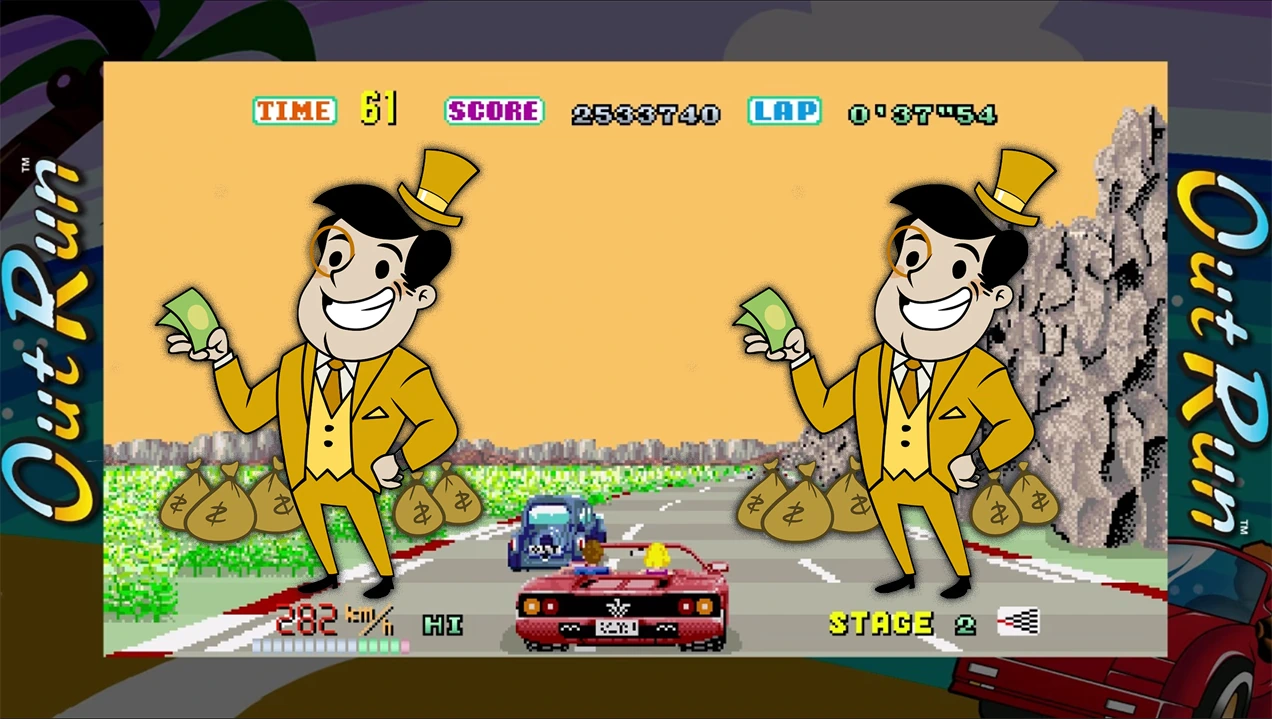
Make a fortune. Find a better way.
AdVenture Capitalist makes money absurd. Each return brings a balance that makes the last one look small. RentRaiser builds toward that feeling through property milestones: buy a building, improve its earnings, and hire a manager to keep rent collecting while you’re away.
The next step is a leaderboard built around three-day runs. A fixed finish line makes every purchase a strategic choice: invest in upgrades, save for the next building, or race to fund an earlier purchase. The aim is a game worth replaying, with new ways to earn faster each time.
The planned leaderboard gives each run a finish line.
The hard part
Drawing a 3D World in a 2D Engine.
The spare linework hides a surprisingly complex engine. Every building starts as points in space. Custom projection math turns those points into screen positions, recalculating their scale and perspective as the camera moves.
Depth sorting, hidden-surface calculations, and a gradual transition into the skyline keep the scene readable. Making it look simple meant getting those systems to agree.
Grab the orange camera. Move it inside the box to change your view.
Outcome
From the original prototype to the browser.
Built first in Godot, RentRaiser now runs natively in the browser with TypeScript and Canvas 2D. Development continues, with the current browser build playable above.
The city ahead
A bigger city. More ways to build.
The playable game now spans three chapters and 28 properties. This earlier architectural study explores building shapes and upgrades that add rooms, improve entrances, and put rooftops to work.
Rent at full occupancy
- Potential / sec
- $3.13
- Purchase
- $100
- Upgrades so far
- $0
Assumes full occupancy and immediate collection. Managers collect on their own schedule.
This design concept has no rent or purchase price assigned in the study.
What’s installed
Three upgrade pathsEntrance
/ 3- AwningsNot installed
- Lights + plantersNot installed
- Seating terraceNot installed
Extra space
/ 3- Side roomNot installed
- Upper roomNot installed
- Roof gardenNot installed
Roof equipment
/ 3- ChimneyNot installed
- Satellite dishNot installed
- Solar panelsNot installed
Move right to add the first upgrade in each path. Earlier additions stay in place.
A / D · ← → Stages